The Unseen Scribe — What Happens When AI Writes the Medical Record
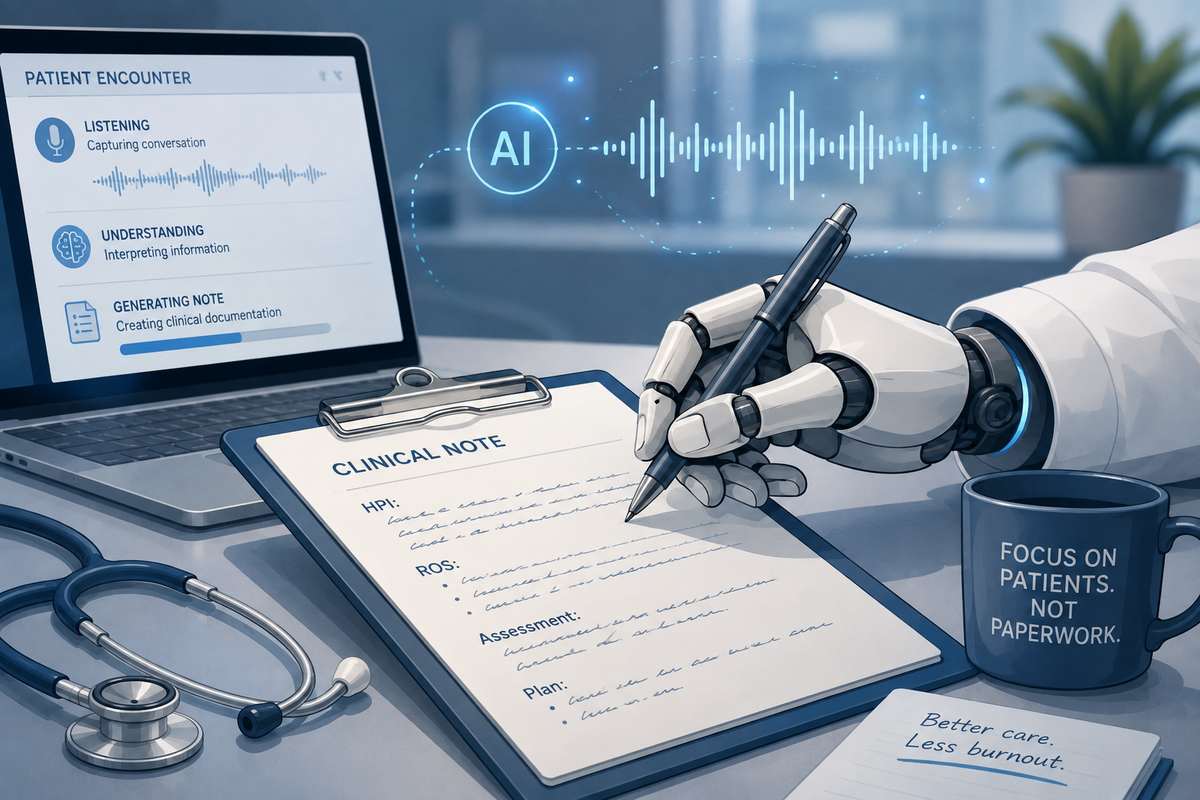
Physicians in the US spend an enormous amount of time documenting care. AI scribes have promised to remedy this issue.
However this technology is far from perfect since it’s release in 2022. They are generating notes that hallucinate exam findings, inflate billing codes and at times, get signed off without doubling checking the data.
These documentation issues aren’t going away anytime soon, they are just in a state of automation at this point.
The Promise
An AI scribe listens to a physician’s appointment and automatically generates a clinical note based on the patient/physician interaction.
One such device named Abridge, notate the conversation ambiently through appointment.
Products like Suki, combine ambient documentation with more traditional dictation and voice-based workflows.
The clinical community is divided about the overall effectiveness of this new technology.
For physicians who have embraced AI scribe technology, hours of manual data input have been eliminated, physicians don’t need to bring home work giving them more free time to spend with their families. Resulting in a better work life balance and less physician burnout.
Patient appointment experience is improved when doctors can be present and actually look the patient in the eye and connect.
But eliminating the keyboard doesn't eliminate documentation errors.
When The Scribe Gets it Wrong
This AI technology has more than few consistent, unresolved glitches that needs to be addressed.
AI scribes rely on microphones but don’t ‘listen’ and understand the way a human does, rather it’s a predictive technology that picks up on patterns on medical notes based on millions of medical documents.
Some work by passively listening throughout the entire visit while others require the physician to dictate directly after seeing the patient.
Products like Suki, combine ambient documentation with more traditional dictation and voice based workflows.
For example, when a physical exam wasn't clearly discussed the AI fills in the gaps with plausible sounding clinical phrases — inserting findings that may never have been assessed and creating a permanent record of care that never happened.
These algorithmic, pattern based false findings end up stored into a permanent medical record. Future doctors could make decisions based on that hallucinated faulty medical information.
An AI scribe device could misinterpret similar drug names and correct dosages. In a busy medical practice, that's one wrong medication documented every week.
When an AI scribe is running one practical tip can reduce errors significantly, Just let one person speak at a time in order to eliminate errors. AI scribes struggle to separate voices and a medication casually mentioned by a family member can end up documented as part of the physician's treatment plan.
Although scribe technology sufficiently limits tedious paperwork by doctors, proof reading and careful editing is essential to it's success.
And while most doctors have a choice as to whether they want to adopt this technology, some have been directed to use it by their health systems, with varying levels of enthusiasm and training. Many clinicians are discovering it’s limitations as it’s a fairly new technology.
A January 2025 study by Medstar Health and Georgetown University found errors in 70% of AI generated notes, with about 3 errors per note. Omissions being the most common and hardest to catch. Catching an omission means remembering something this isn’t there at the end of the day after a busy shift.
The Automation Bias Issue
What happens next is known as ‘automation bias’. The better the AI Scribe product performs the more a physician will trust it, with less criticism when taking inputting data.
Clinicians might accept the output as fact based on the presentation of data.
When a physician signs an AI generated note they are legally attesting to its accuracy.
The Centers for Medicare and Medicaid Services requires that documentation support whatever is billed, making an unreviewed AI note not just a clinical risk but a potential compliance violation.
There is no standardized national consent process for AI scribes in the United States.
A common practice is to ask the patient if it’s ok to turn on the AI scribe at the beginning of an appointment.
But many physicians don't ask at all. In states like California, Florida, and Illinois all parties must legally consent to being recorded. Three major California health systems, Sharp Health Care, Sutter Health, and Memorial Care now face class action lawsuits alleging patients were recorded without consent. The legal framework around AI scribes is still catching up.
What clinicians and patients should ask
In order for AI scribe technology to reach peak effectiveness, each note needs to be checked for accuracy before submission.
The most common inaccuracies occur in the physical exam and medication note sections, these areas require special attention. Keeping information from a previous appointment risks cross contaminating one patient's record with another's data.
For Patients:
At the start of every appointment, ask the clinician if an AI scribe is being used. And keep in mind that a patient has the right to decline. Appointment notes can be viewed by the patient before it’s finalized. Ask who reviews the AI generated note before it becomes your permanent record. Patients in all-party consent states, including California, Florida, Illinois, Maryland, and Massachusetts among others, have the legal right to be asked before any recording begins.
When Better Documentation Means Bigger Bills
Ai scribe technology saves physicians time as well as how much a practice is getting paid.
More complete notes can capture more medical details than previously documented, additional conditions can be addressed, test results can be reviewed, medications considered, and treatment decisions can be made. These details can result in higher bills to the provider.
For example, a physician can treat a patient for their primary condition while reviewing a separate complaint, while adjusting medication dosage, and reviewing lab results, all in the same visit.
The additional issues might not be documented without an Ai scribe. The scribe can support the bill accordingly and collect higher fees from the patients insurance company.
For physician practices, that's previously missed revenue.
For insurance companies, it's potentially a more expensive claim.
What happens when AI becomes involved on both sides of the claim?
AI scribes are already changing what gets documented. What's less discussed is what happens next.
The financial implications don't stop with the provider.
Provider AI documents the visit and supports the bill. Insurer AI scrutinizes the claim.
And the physician remains legally responsible for everything originally written.
The U.S. Government Accountability Office recently flagged this emerging dynamic, noting that AI documentation and coding tools could increase costs for insurers, employers, and patients.
As AI-generated documentation becomes more common, insurers have more of an incentive to use their own AI systems to scrutinize those claims.
AI scribes have the potential to give physicians something healthcare desperately needs, more time with patients and less time behind a keyboard.
But of course the implementation of this technology should not come with the compromise of accuracy and transparency.
Patients need to know when AI is listening, physicians need to know exactly what they're signing, and health systems need to understand how automated documentation may affect billing and insurance scrutiny.
This technology is bound to improve since it’s introduction in 2022. AI should strengthen the physician-patient relationship
Comments ()